You need to know which marketing campaigns work, which pages perform best, and where visitors leave.
But how do you get these answers without violating your visitor’s trust or breaking privacy laws?
Privacy-first analytics has moved from a minor concern to a business requirement.
With authorities tightening rules under GDPR, CCPA, and a growing list of global privacy laws, getting your analytics approach wrong can result in heavy fines, lost customer trust, and unnecessary legal issues.
The good news is that there are digital analytics solutions that respect privacy, provide the essential data you need, and keep visitor information completely safe.
This guide explains what privacy-first analytics actually means, why it matters, and which tools are worth your time and money.
What is Privacy-First Analytics and Why Does it Matter?
Privacy-first analytics is the practice of collecting website and product usage data in a way that respects visitor privacy by default.
Traditional analytics tools like Google Analytics 4 collect extensive personal data, store it on third-party servers, and use it for ad targeting.
Privacy-first analytics tools do the opposite.
They collect only what is necessary and focus on aggregate, anonymous data that tells you what you need to know without exposing your visitors.
- No personal data collection: These tools collect page views, sessions, and events without storing IP addresses, device fingerprints, or user IDs. Your visitors remain anonymous.
- No cross-site tracking: Privacy-first tools only track activity on your website. They do not follow visitors to other sites or build profiles of their behavior elsewhere.
- No cookies: Most operate entirely without cookies. Some use first-party cookies that never leave your domain, but they never use third-party tracking cookies.
- Data minimization: These tools collect only what you actually need, such as page views, referral sources, browser types, and country-level location.
Now you might think: “My business is small. Privacy laws do not apply to me.”
Or: “I have used Google Analytics for years. Why change now?”
Here is why it matters.
Breaking Privacy Laws Have Consequences
The days of “collect everything and figure it out later” are over.
GDPR fines have exceeded €4 billion in total since enforcement began.
The EU’s Digital Omnibus regulation may simplify some consent requirements, but it also reinforces that tracking without permission is illegal.
CCPA enforcement in California is active, and similar laws now exist in over 15 US states, Brazil (LGPD), Canada (PIPEDA), and dozens of other countries.
If your analytics tool collects personal data without proper consent, you face legal liability.
Third-Party Cookies Are Effectively Dead
Even if you ignore privacy laws, browsers do not.
Safari and Firefox have blocked third-party cookies for years. Chrome now leaves the decision to users, and most of them choose to block tracking.
Ad blockers and privacy extensions also prevent old analytics scripts from working.
The shift to cookieless tracking solutions is no longer optional.
Server-side tracking solves this problem by moving data collection from the browser to your own servers. Events get captured and sent directly to your analytics platform.
This improves accuracy, reduces page load times, and gives you far more control over what data is shared.
Visitors Actually Care About Privacy
A growing percentage of users now run ad blockers, use privacy-focused browsers and Google search alternatives, or actively reject tracking cookies. If your analytics relies on third-party scripts or cookies, you’re likely missing 20–40% of your actual traffic.
Privacy-first analytics tools are designed to work without cookies, which means greater data accuracy, not just better ethics.
This builds trust, leading to more conversions and stronger customer relationships.
The Best Privacy-Focused Analytics Tools
Before you pick a tool, here’s what you need to consider:
- GDPR and CCPA compliance: The tool should not require cookie consent banners for basic analytics. That’s a sign it doesn’t collect personal data in the first place.
- Data ownership: You should own your data, ideally with the option to self-host or export it freely at any time.
- First-party data collection: Your analytics data should come from your own domain, not a third-party script that can be blocked.
- Transparent pricing: No surprise charges as your traffic grows.
- Ease of use: No one wants complex dashboards. Good privacy-first tools give you the key metrics in a simple dashboard that you can view at a glance.
Now let’s get to the fun part: which tools actually deliver?
We evaluated dozens of options based on privacy, ease of use, and value.
Here’s what made the cut:
Vemetric
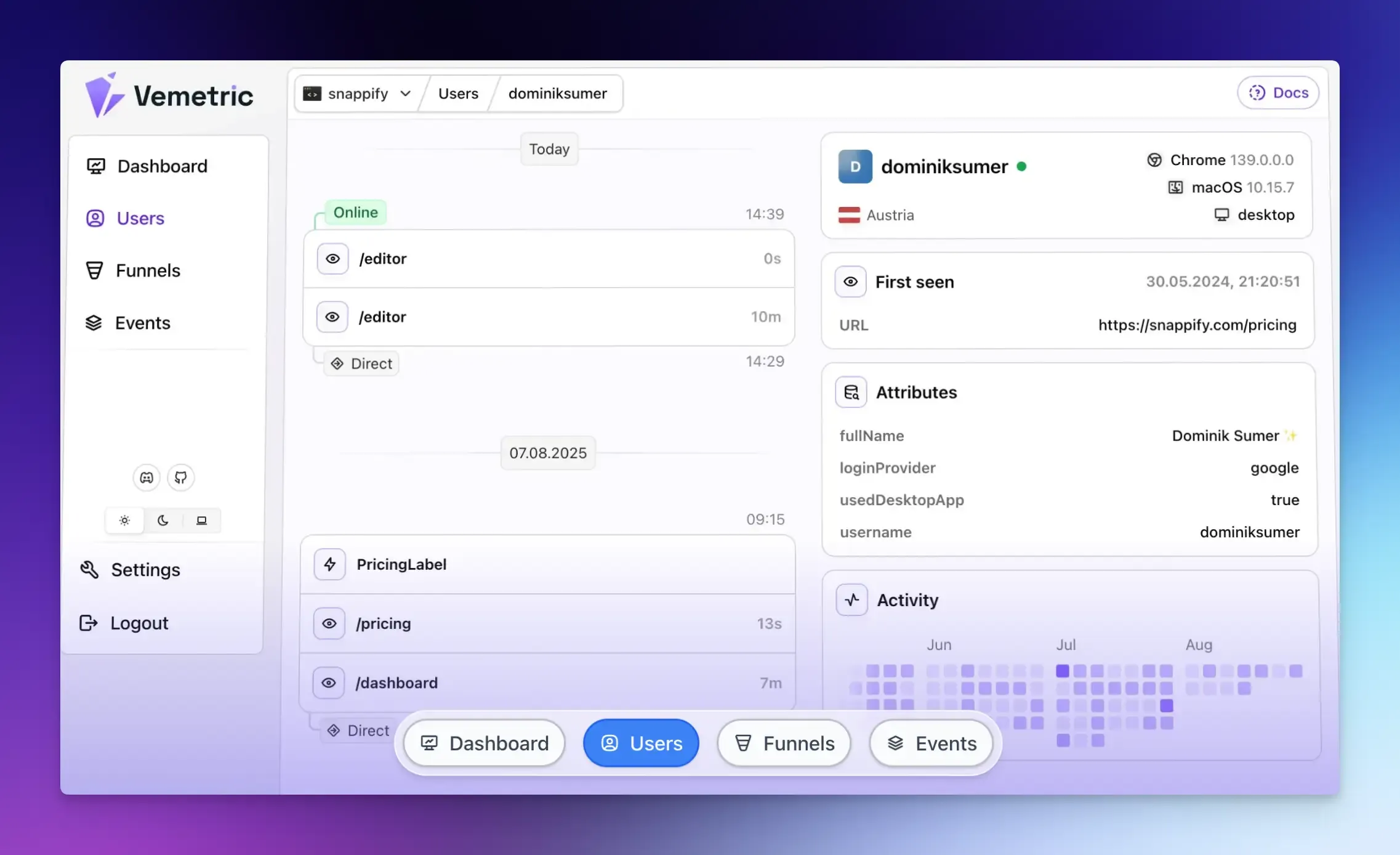
Vemetric is a privacy-first, open-source analytics tool for businesses that want powerful product analytics and complete privacy without compliance issues.
It combines simple website analytics with product analytics into a single, easy-to-understand dashboard.
Vemetric collects zero personal data by default. That means no IP addresses, cookies, or tracking across sessions.
Yet you still see exactly which marketing channels drive traffic and where your visitors drop off.
Best for: Ecommerce stores, SaaS products, and content sites that want both web analytics and product analytics without managing multiple tools.
Key Features:
- Cookieless tracking, GDPR, and CCPA compliant out of the box.
- Real-time dashboard showing active visitors.
- Campaign attribution without personal data
- Event tracking and user journey analysis.
- Funnel analysis for conversion optimization.
Pricing: Free plan available. Starts at $5/month for 10k events.
Plausible Analytics
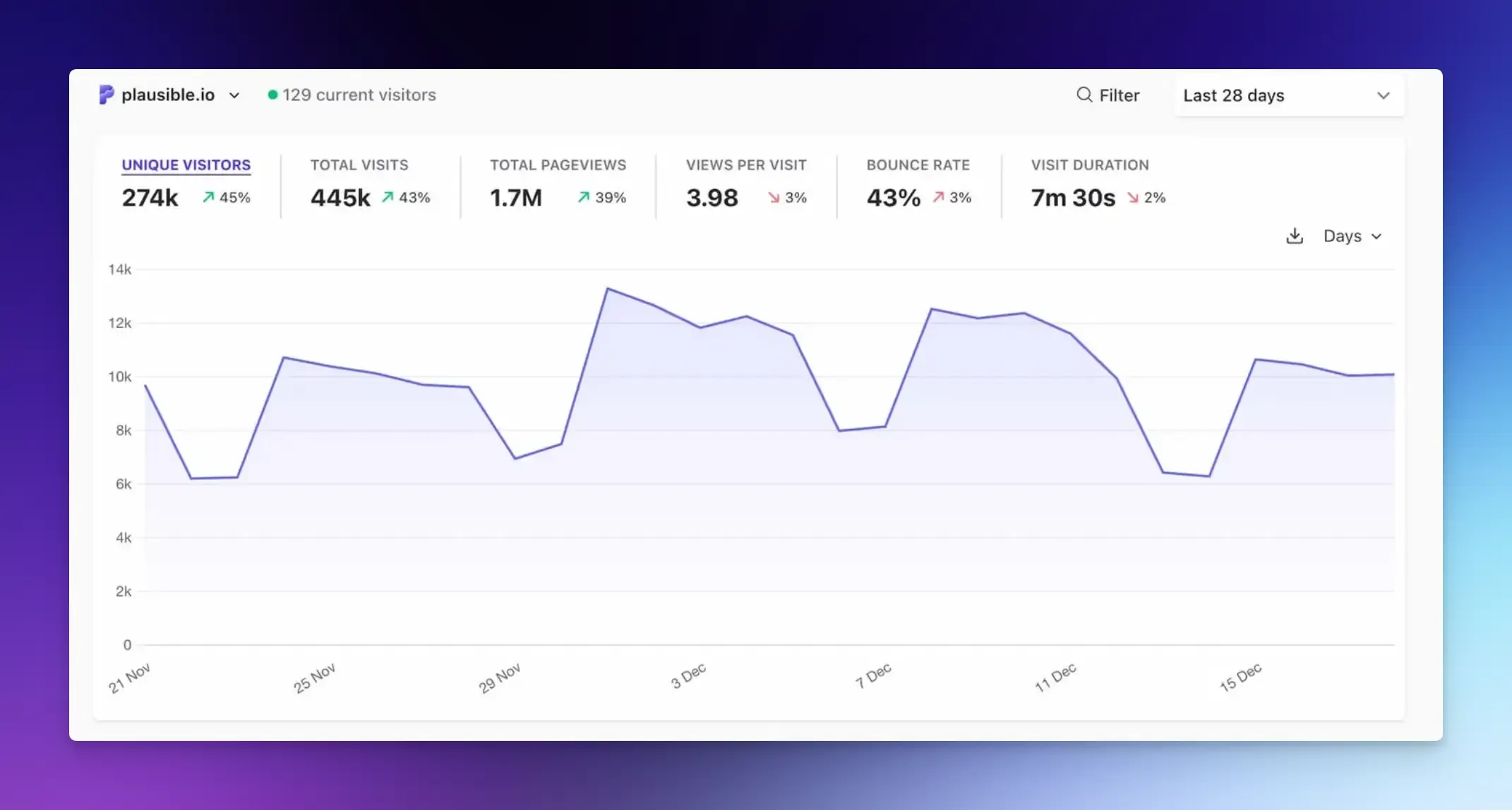
Plausible is one of the most popular Google Analytics alternatives for good reason. It built its entire reputation on privacy, and its open-source code is publicly available for anyone to verify what the tool collects.
Best for: Content and marketing sites, blogs, small businesses, and anyone tired of complex analytics dashboards.
Key Features:
- One-page dashboard that’s easy to understand.
- GDPR compliant without a consent banner.
- Can be self-hosted for full data ownership.
- Lightweight tracking script (under 1KB).
Pricing: Starts at $9/month for 10k pageviews. The self-hosted version is free.
Matomo
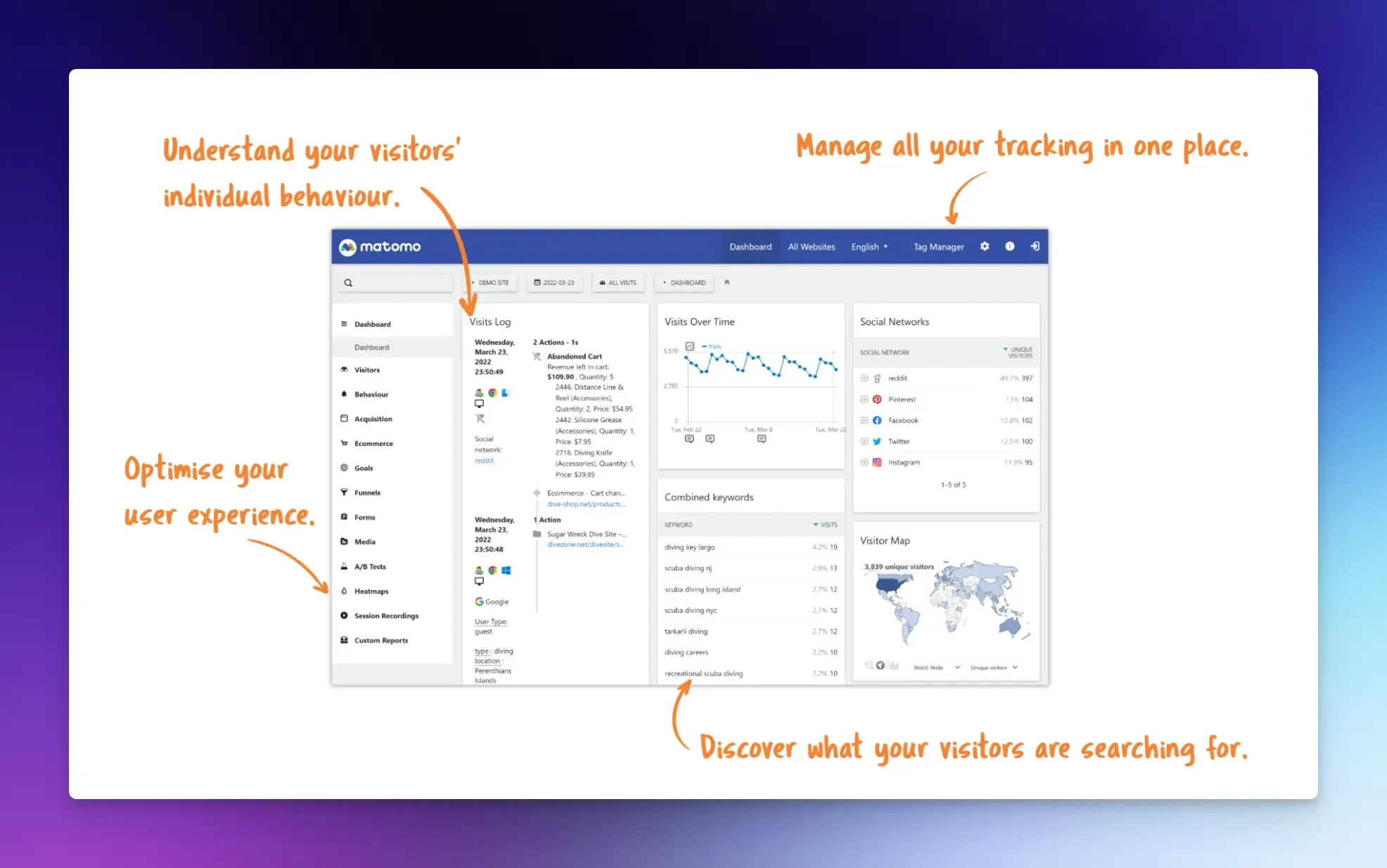
Matomo is the closest thing to a full Google Analytics replacement if you need heatmaps, session recordings, A/B testing, and advanced reporting, but with privacy built in. You can self-host it completely, keeping all data on your own servers.
Best for: Enterprises and teams that need full data control and complex compliance requirements.
Key Features:
- Built-in Google Analytics data importer.
- Self-hosted or cloud options.
- Heatmaps, A/B testing, and session recordings.
- GDPR and CCPA compliance tools built in.
Pricing: Starts at €22/month for 50k website hits. Free self-hosted version.
PostHog
PostHog is for product teams and developers who need deep insight into user behavior. It combines product analytics, feature flags, session recording, and A/B testing into a single platform.
Best for: SaaS companies and product teams that want one platform for everything without breaking privacy rules.
Key Features:
- Product analytics and user behavior tools.
- Event autocapture without manual tracking setup.
- Can be configured without cookies.
- Open-source with a self-hosting option.
Pricing: Free up to 1 million events per month. Usage-based pricing beyond the free tier limits.
Fathom Analytics
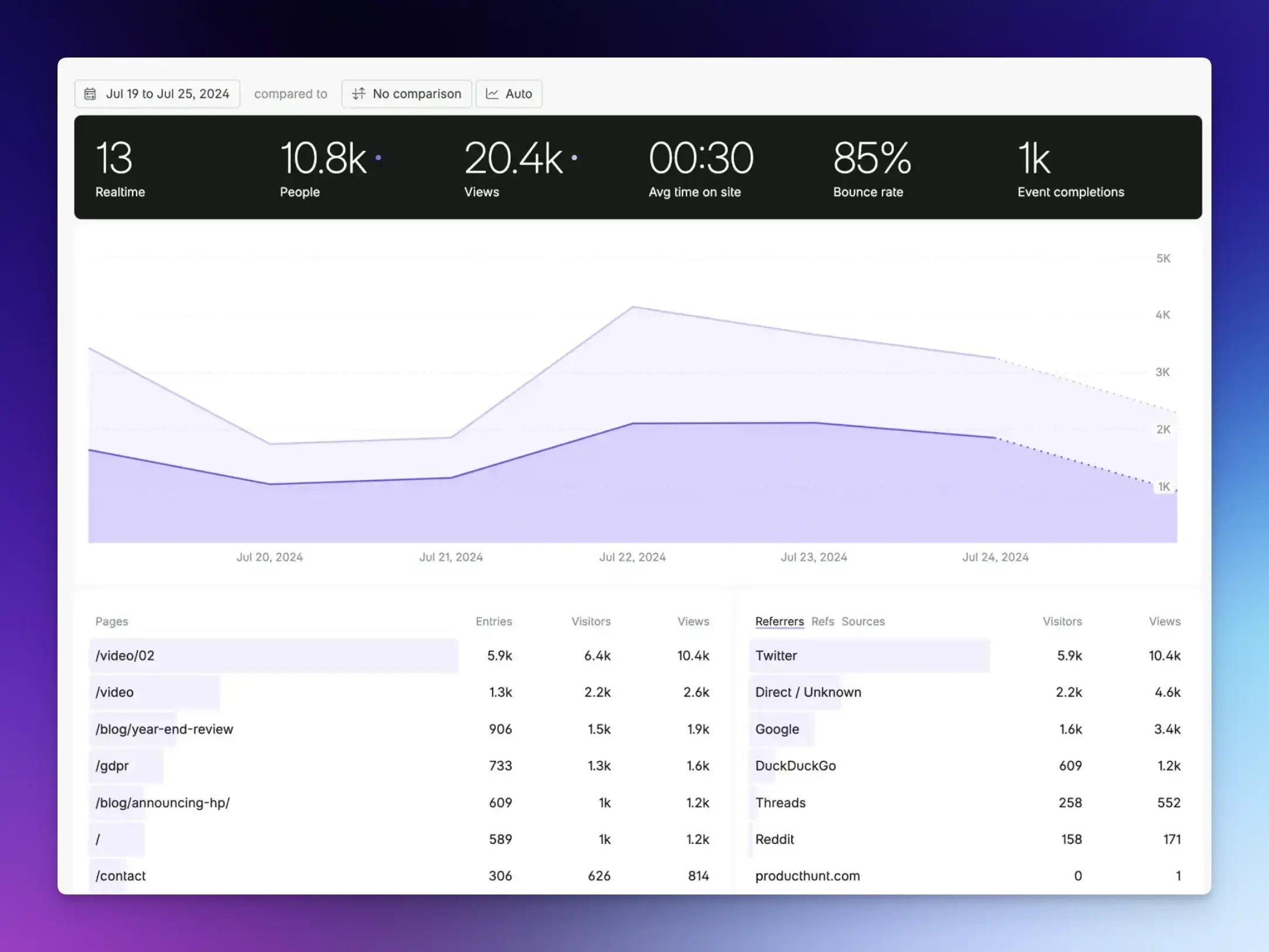
Fathom is for teams that prefer simplicity above all else. The one-page dashboard shows exactly what matters.
Best for: Small business owners who want a simple, reliable, and compliant solution with great support.
Key Features:
- EU data isolation for GDPR compliance.
- Bypass ad blockers with a custom domain setup.
- No cookie banner required.
- Forever data retention.
Pricing: Starts at $15/month for 100,000 pageviews.
Umami
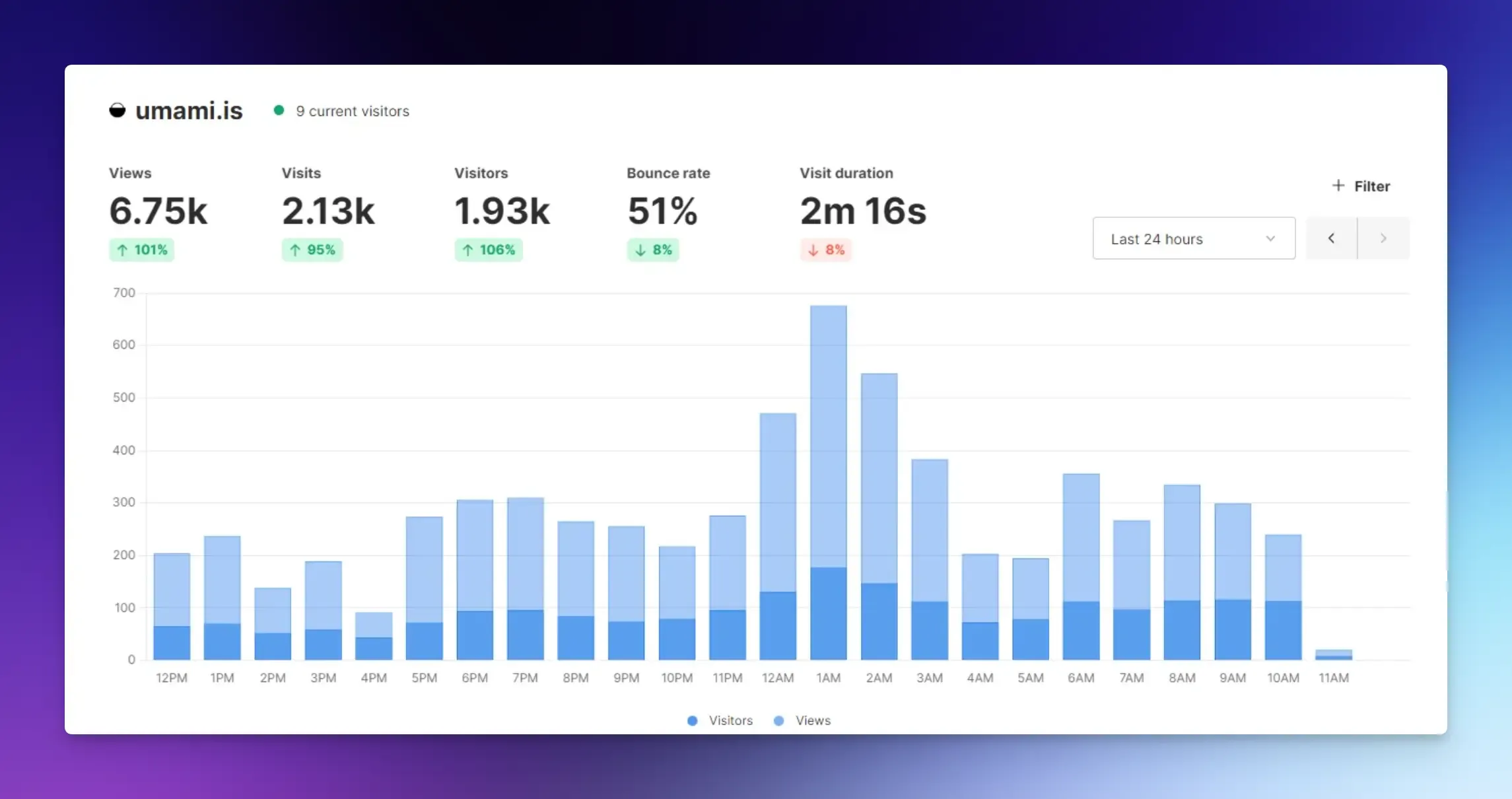
Umami is a simple, open-source solution that anyone can self-host. It is extremely easy to install and run. If you can use Docker, you can have Umami running in minutes.
Best for: Developers and website owners who want to host their own analytics.
Key Features:
- Lightweight and fast performance.
- Simple custom event tracking.
- Funnels, retention, and UTM tracking.
- Data anonymization to protect your visitors’ privacy.
Privacy approach: Self-hosting means you control everything. Cookieless by default. No personal data collected.
Pricing: Starts at $20/month for 1 million events. Free self-hosted version.
Final Words
Modern privacy-first analytics tools give you valuable insights without the legal risks, user consent issues, or dependency on a platform that profits from your user data.
Each of the tools listed here takes a slightly different approach and is best for different use cases.
In most cases, you’ll actually get better data to run your business while respecting everyone who visits your site.
FAQs
These tools accurately track UTM parameters and referral sources. You see which ad campaigns, keywords, and platforms lead to conversions.
With most paid privacy-first tools, you can export all your data before canceling. Self-hosted options let you keep everything forever since the software runs on your servers.
Most privacy-first tools work with any website. You can integrate them with WordPress, Shopify, Webflow, Wix, and custom-coded sites.