Product launches are turning points that can determine your business’s future.
You ship the feature and update the website, but then you face a pressing question: Is it working?
Without a plan to track key metrics, you might build features people rarely use or waste money on ads that drive signups but no long-term users.
This is where product launch analytics changes the process.
This guide walks through the key metrics you should track and how you can measure them with simple tools.
By the end, you’ll know what data matters most at launch and how it fits into your larger growth plan.
Let’s get started.
What is Product Launch Analytics? Importance and Benefits
Product launch analytics is the process of measuring how users interact with a new product or feature from the moment it becomes available.
One major reason most product launch plans fail to meet their goals is how teams use data from day one. They rush into promotion and sales and miss early signs of user hesitation and weak feature adoption.
Product launch analytics give you a real-time view of what works and what doesn’t.
It shows you which features people love, how well your marketing performs, and where your team should focus its efforts.
It answers questions like:
- Who signed up?
- How often did they use the product?
- Where and why did they drop off?
- Which channels produced the most value?
This gives you valuable insights into what is happening with your product and the initial market response right after launch.
It also helps you track user journeys that lead to actual engagement and revenue contribution.
Here are the main benefits of product launch analytics for SaaS owners:
- Move from vanity metrics to truth: Many SaaS teams focus on vanity numbers like total downloads or likes. Those stats look nice, but they mean little if those users never return or find value. Product analytics tracks user actions based on specific events. This tells you if you’re attracting the right users or just random visitors.
- Identify friction points immediately: With a proper launch analytics setup, you see the leaks in the funnel. You can then fix that step before the majority of your users even see it, significantly improving the experience.
- Measure genuine value: Instead of just tracking how often a feature is used, product launch analytics shows you if it is achieving the desired results. This connects the launch directly to your product’s core value proposition. It answers whether this new feature is making your customer’s lives better in a measurable way, which is the ultimate source of retention and growth revenue.
- Optimize resource allocation: Product analytics provides data on user engagement, retention, and conversion paths. This means your team makes choices based on evidence, not opinions on what to fix or build next. You can allocate development time and marketing effort toward what actually matters.
Key Product Launch Metrics to Track
Here are the key performance indicators every SaaS owner should track.
Activation Rate
Actiation rate is the percentage of new users who complete a specific action. It shows they have started using your product in a meaningful way and have reached a defined first-value moment with your new launch.
Why it’s important: A low activation rate is the biggest red flag. You can have 1000 signups, but if only 100 activate, you have a problem. It means new users are confused or not seeing value quickly enough. Your onboarding, user interface, or initial value proposition for the launch is failing.
User Adoption Rate
This is the percentage of your target audience that is actively using the new product.
It evaluates market fit and perceived value for the intended user segment. It answers: Are the people you built this for actually using it?
Why it’s important: A launch can have a high activation rate but a low adoption rate. This shows that while users who try it get value, you are failing to communicate its relevance to the broader target group.
Time to Value
Time to value tells you how long it takes a new user to reach the first benefit after signing up.
It measures how quickly you can help users see the real value your product delivers.
Why it’s important: Shorter times mean users get immediate value and are more likely to stay engaged and convert to paying customers. If new users take too long to understand how your product works, many will drop off before they ever see value. So tracking it tells you where users struggle and where to focus effort to improve the early user experience.
Customer Retention Rate
Retention rate is the percentage of users who continue to use your product after they first sign up.
Why it’s important: For SaaS products, retention is one of the most important measures of long-term success. High retention means users are sticking with your product even after the launch hype fades. Low retention means your product may not be meeting core needs.
Feature Adoption Rate
This is a combination of two things: how much users interact with specific features of your product, and how often they return to it.
Why it’s important: This tells you if your launch is a nice-to-have or a must-have tool. If users only use 10% of the functionality, the rest is too complex, poorly designed, or doesn’t solve a real need.
Customer Acquisition Cost (CAC)
CAC measures the cost of acquiring a new customer. This covers marketing spend, sales effort, and any other costs associated with acquiring new users.
Why it’s important: During a launch, CAC tells you how efficient your acquisition channels are. If you spend a lot but get few users, you may need to rethink your launch strategy and campaign targeting.
Net Promoter Score (NPS)
The Net Promoter Score (NPS) measures customer satisfaction and loyalty by asking how likely customers are to recommend your product.
Why it’s important: NPS gives you insight into how your early adopters feel about your product. A high NPS indicates users are satisfied and are likely to promote your product, which can drive organic growth. Low NPS signals user frustration or unmet expectations. Tracking this after launch allows you to better understand user sentiment and make improvements based on real feedback.
Social Media Engagement
Social media engagement shows how your audience reacts to your launch announcements, feature teasers, and related content.
What it measures: It tracks likes, shares, comments, mentions, and engagement rates across your social channels.
Why it’s important: Strong engagement means your content resonates and builds anticipation. If engagement is low, you should rethink your content strategy or your audience targeting before launch.
Website Engagement
You want to direct people to your landing page or blog posts about the product. Tracking website traffic and engagement metrics helps you understand how many people are actively checking your product information and how long they stay interested.
It includes total visitors, unique page views, conversion rate, bounce rate and session duration.
Why it’s important: If traffic grows steadily and visitors spend time reading or interacting with key pages, it indicates interest and relevance. Otherwise, you might need stronger content and a marketing strategy.
How to Track Your Product Launch with Vemetric?
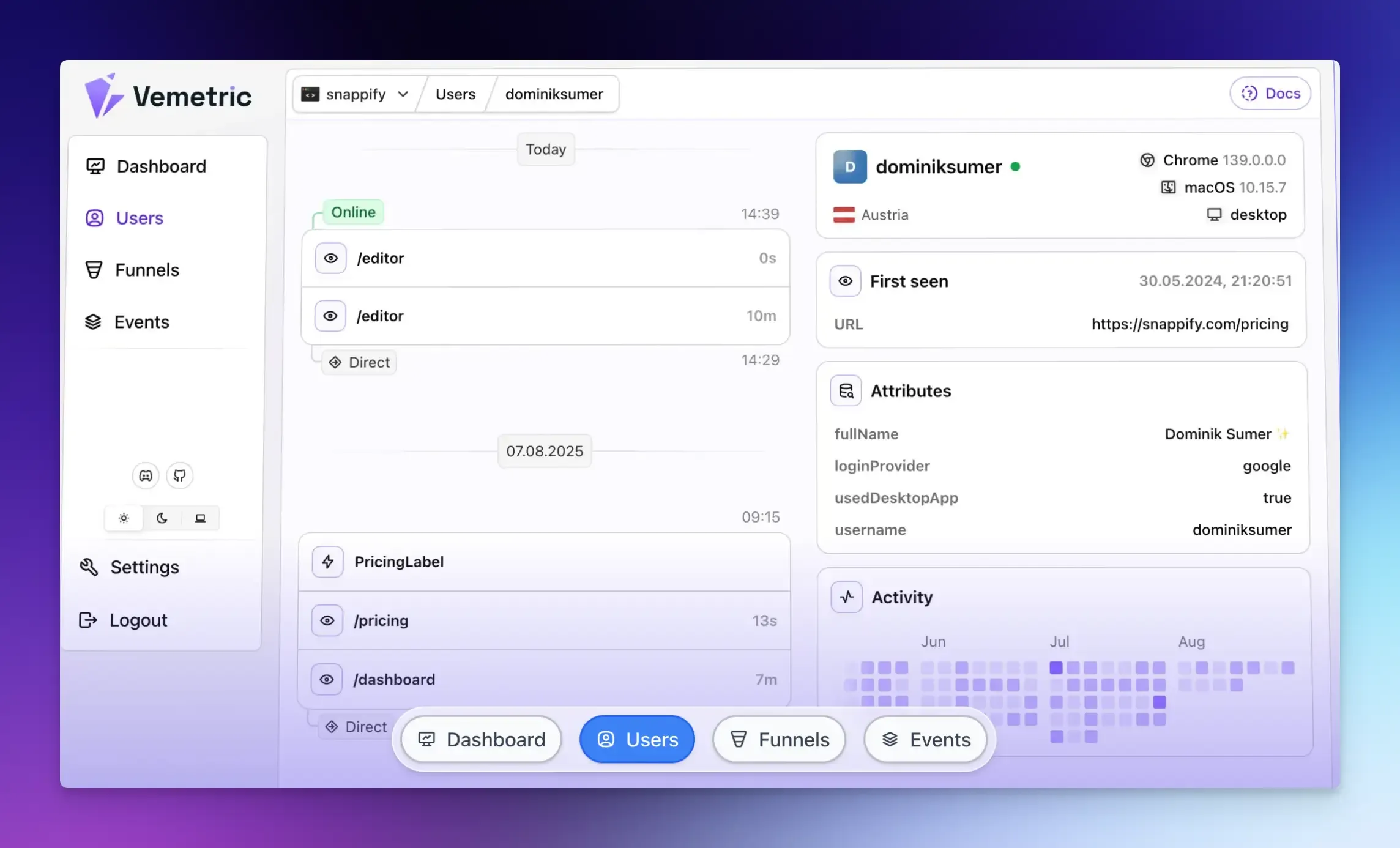
Choosing the right analytics tools is crucial for successful product launch.
Tools like Vemetric are built for this exact purpose, providing suitable web and product analytics to keep all launch data in one place.
Here are the effective steps you can follow to track the right things at the right time.
Define Goals and KPIs
Before launch, set SMART goals (specific, measurable, achievable, relevant, and time-bound). This will help you decide which metrics matter most to your business.
Knowing these in advance lets you set up event tracking properly.
Implement Event Tracking
Install Vemetric by integrating its SDK into your project. Then, configure it to track your KPIs.
Once this setup is complete, Vemetric will track basic interactions like page views and outbound clicks automatically without using cookies.
- Identify Your Users: For logged-in users, assign a unique User ID. This allows Vemetric to merge a user’s anonymous browsing with their logged-in activity in your app, giving you a complete view of the entire user journey.
- Track Custom Events: Use the SDK to send events for the key actions you defined to see how users interact with your product.
- Track Traffic and Campaigns: Connect your website and landing page analytics to see where your visitors come from, including email campaigns, Google ads, social media posts, and referral sites. This helps you judge which marketing channels are driving real interest.
Use the Dashboard to Monitor in Real Time
Once events are coming in, Vemetric’s dashboard lets you monitor launch activity as it happens for a high-level view of traffic and engagement.
It shows:
- Page views and unique visitors
- Popular events and interactions
- User properties such as location or device
- Referrers and UTM campaign data
You can filter and segment the data by event type or user property to see how specific launch activities are performing.
Analyze Launch Performance
Use Vemetric’s product analytics to understand user engagement.
- User Journeys: See the exact path each user takes through your product, including what they did and in what order. This helps you confirm whether users are moving through launch flows as you planned and where they may be dropping off. You can inspect a single user’s timeline or filter to see patterns across different user groups.
- Funnels: Create a funnel with the steps of your launch and see conversion and drop-off numbers at each stage.
Final Words
A successful product launch requires focusing on the right metrics and using the proper tools.
Vemetric gives you a privacy-focused way to track this journey by showing exactly how users find and adopt your new product, helping you optimize specific parts of your launch strategy based on real user behavior.
FAQs
Avoid mistakes such as tracking vanity metrics, failing to record pre-launch metrics, ignoring user segments, and implementing too many complex analytics tools at once.
Start collecting data from the moment your tracking system is live, ideally before launch.