Your next customer might never see your homepage before they’ve already made up their mind about you.
They ask ChatGPT to compare analytics tools.
They ask Perplexity which SaaS product fits their use case. They read a two-paragraph AI answer, form an opinion, and only then, if at all, click through to a website.
If your product wasn’t mentioned in that answer, you didn’t lose a click. You lost the buyer’s shortlist entirely.
This is the reality behind generative engine optimization, or GEO: the practice of getting your brand cited, mentioned, and recommended inside AI-generated answers instead of just ranked on a results page.
For SaaS companies, GEO isn’t a future trend to watch. It’s already reshaping how software gets discovered, evaluated, and bought.
This guide breaks down what GEO actually means for SaaS, how it differs from traditional SEO, and why analytics, not just content, is the piece most teams are missing.
What Is Generative Engine Optimization (GEO)?
GEO is the practice of structuring your content and online presence so that AI systems like ChatGPT, Claude, Perplexity, Google AI Overviews, and Gemini reference your brand when answering a user’s question.
Researchers at Princeton, Georgia Tech, and IIT Delhi formalized the term. Found that targeted optimization techniques, like adding statistics, citing credible sources, and including direct quotes, can lift a page’s visibility in generative engine responses by up to 40%.
The easiest way to understand GEO is to see how it differs from the two disciplines it sits next to:
- SEO (Search Engine Optimization): Gets your page ranked in a list of links on a results page. Success is measured in position and clicks.
- AEO (Answer Engine Optimization): A closely related term that focuses specifically on being selected as the direct answer to a question, whether that’s a featured snippet or a voice assistant response.
- GEO (Generative Engine Optimization): Gets your brand mentioned, quoted, or recommended inside an AI-written summary, often with no click required at all. Success is measured in citations, mentions, and share of voice.
They overlap heavily. Strong SEO fundamentals still matter for GEO, since generative engines have to find and crawl your content before they can cite it. But the content structure, the trust signals, and the way you measure success are genuinely different.
Traditional SEO vs GEO for SaaS Content
Neither discipline replaces the other. Ranking well still helps generative engines find and trust your content.
But if your SaaS content strategy stops at keywords and backlinks, you’re optimizing for a channel that’s sending an ever-shrinking share of clicks.
Goal:
- Rank in the top results
- Get cited or mentioned in the AI-generated answer
Success metric:
- Position, clicks, CTR
- Citation rate, brand mentions, share of voice
Strongest signal:
- Backlinks, domain authority
- Brand mentions across the web, structured and specific content
Content format:
- Keyword-optimized long-form pages
- Direct answers, bullet points, FAQs, original data
Where you show up:
- Your own listing on a results page
- Woven into someone else’s AI-generated summary
What you can measure directly:
- Rankings and organic sessions
- Referral traffic from AI platforms, mentions, and downstream behavior
The Real Problem: Most SaaS Teams Are Flying Blind on AI Search
Here’s where most GEO advice falls short. Plenty of guides will tell you to add statistics, cite sources, and build brand mentions. Far fewer will tell you how to know if any of it is actually working.
Standard analytics setups weren’t built for this.
Referral data from AI platforms is often incomplete or stripped out entirely by the time it reaches your reports, so a visitor who came from a ChatGPT answer can easily get lumped in with “direct traffic” or vanish from your reporting altogether.
That leaves SaaS teams with a strange blind spot: they can see their overall traffic is holding steady or growing, but they have no idea how much of it is coming from AI search, which content is earning those citations, or whether those visitors ever convert.
This is exactly the gap we cover in more depth in our guide to tracking AI referrers and visibility metrics, but it’s worth stating plainly here: you cannot manage a GEO strategy you can’t measure. Content changes without measurement are just guesses with better formatting.
How Analytics Turns GEO From Guesswork Into a Growth Loop
This is where analytics stops being a reporting afterthought and becomes the backbone of your GEO strategy. Here’s what that looks like in practice.
See exactly where your AI traffic is coming from
Vemetric automatically identifies and categorizes referral traffic from AI platforms like ChatGPT and Perplexity, without you having to tag URLs or build custom filters manually.
Under Top Referrers, you can see at a glance how much of your traffic is arriving from AI tools versus organic search or social, and that split alone often surprises SaaS teams the first time they see it.
Find out which content is actually earning citations
Getting mentioned by an AI engine only matters if it’s happening on the pages that move your business forward.
By looking at which specific blog posts, docs, or comparison pages are attracting AI-referred sessions, you can reverse-engineer what’s working and double down on it. We go deeper into how to run this kind of visibility check in our guide on tracking which pages get cited by AI.
Compare AI-referred visitors to everyone else
Traffic volume alone doesn’t tell you if GEO is paying off. With user journey tracking, you can see whether visitors arriving from AI platforms behave differently from visitors from Google or a newsletter: do they explore more pages, sign up at a higher rate, or bounce immediately? That answer should shape how much further you invest in GEO.
Close the loop with funnels
Once you know which content brings in AI-referred visitors, funnels show you what happens next: do they hit your pricing page, start a trial, or drop off before activation? This turns “we got mentioned by ChatGPT” into “we got mentioned by ChatGPT, and it drove 12 trial signups,” which is the number that actually justifies the strategy internally.
A Practical GEO Framework for SaaS Teams
If you’re starting from scratch, here’s a straightforward, five-step approach to building a real GEO strategy rather than a handful of scattered tactics.
1. Audit your current AI visibility:
Before changing anything, find out where you stand. Run the questions your buyers would actually ask (best analytics tools for SaaS, alternatives to X, is Y worth it) through ChatGPT, Perplexity, and Google AI Overviews, and note whether your brand shows up, how it’s described, and who shows up instead of you.
2. Structure content the way generative engines actually read it:
The Princeton GEO research is consistent on this point: content that includes specific statistics, cites credible sources, and answers questions directly gets cited more often than vague, keyword-stuffed prose.
In practice, that means:
- Answering the core question in the first two or three sentences of a section
- Using bullet points and short paragraphs instead of dense blocks of text
- Backing claims with named, dated sources
- Including a clear FAQ section that mirrors how people actually phrase questions
For a step-by-step approach to planning content this way, see our guide on building GEO content briefs.
3. Earn brand mentions, not just backlinks:
Since branded web mentions correlate far more strongly with AI visibility than backlinks do, prioritize getting your product mentioned in comparison articles, on review platforms like G2 and Capterra, in community discussions, and in industry roundups, even when they don’t link back to you.
4. Make sure AI crawlers can actually reach your site:
None of the above matters if bots like GPTBot, ClaudeBot, and PerplexityBot can’t access your content in the first place.
Check your robots.txt file and server logs to confirm you’re not accidentally blocking the crawlers you’re trying to attract. Our AI crawler optimization guide walks through exactly how to check this.
5. Track, measure, and iterate:
Set a baseline for your AI referral traffic today, then revisit it monthly.
Watch which pages gain or lose AI-referred sessions after you update them, and treat GEO the same way you’d treat any other growth channel: as a loop of hypothesis, publish, measure, and refine, not a one-time content sprint.
How Vemetric Fits Into Your GEO Stack
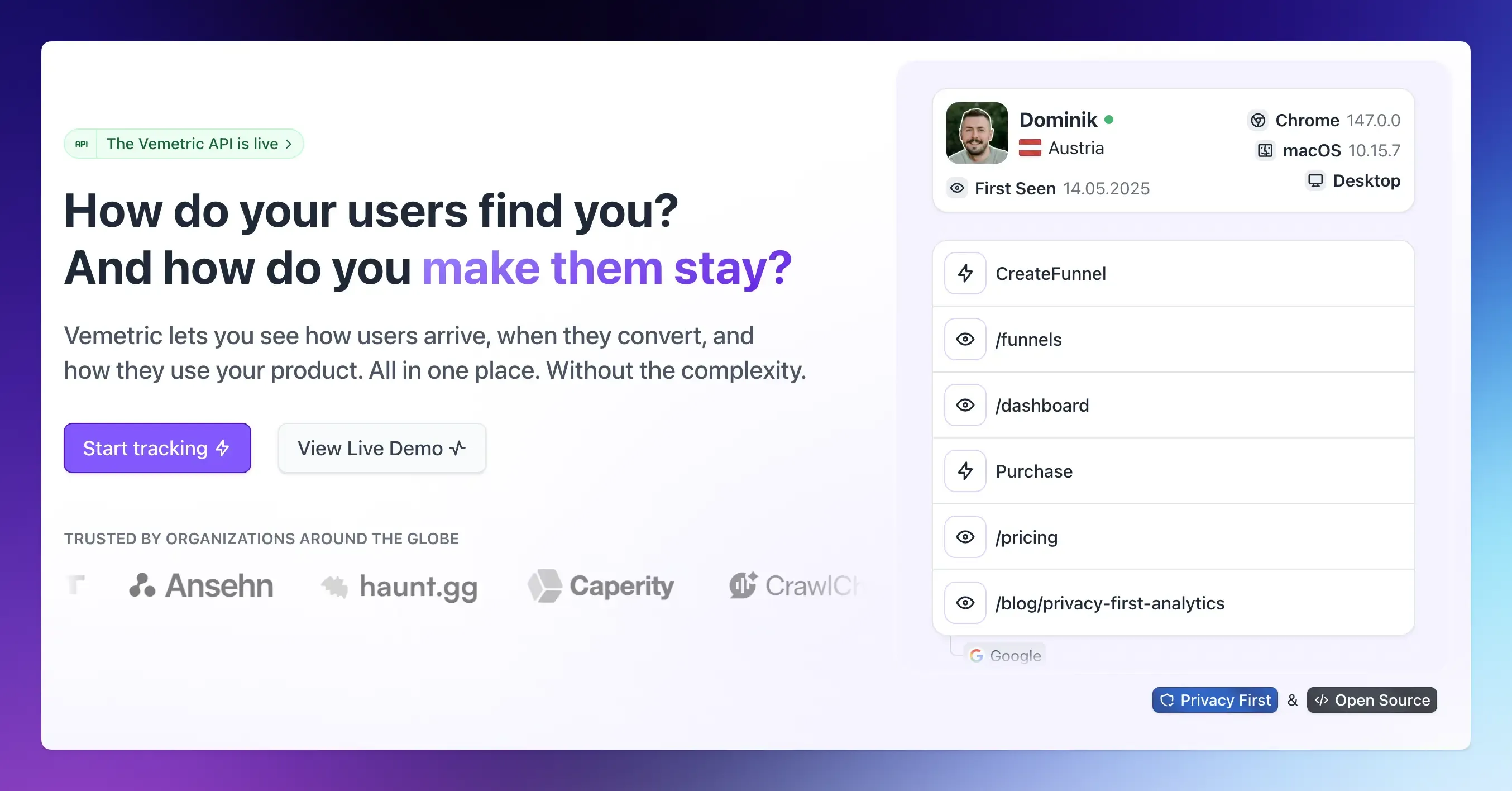
Vemetric was built to answer a simple question that most analytics tools make surprisingly hard to answer: what are people actually doing on your site, and where did they come from?
For SaaS teams running a GEO strategy, that translates into a few concrete capabilities:
- Automatic AI referrer detection: so ChatGPT, Perplexity, and other AI-driven traffic show up clearly instead of getting buried in “direct” or “unknown” sources
- Top pages and top referrers views: To see exactly which content is pulling AI traffic and where it’s coming from
- User journeys: Tracking each visitor’s full path, including anonymous browsing that later converts into a signed-up user
- Funnels: To connect AI visibility directly to signups and activation, not just sessions
- Event streams: Giving you a real-time, chronological view of what’s happening across your product
It’s also built with the constraints SaaS teams actually operate under in mind: it’s open source, doesn’t use cookies by default, is GDPR-compliant, has servers based in the EU, and never sells your data.
You get one analytics tool for both your marketing site and your in-product behavior, instead of stitching together a web analytics tool, a product analytics tool, and a spreadsheet to answer the question “Is our GEO strategy working?”
Pricing starts at $0/month for up to 2,500 events, with the Professional plan starting at $5/month for unlimited projects, unlimited seats, and 5 years of data retention.
Final Thoughts
GEO isn’t replacing SEO. It’s a natural response to where your buyers now start their research: inside an AI conversation, before they ever land on a results page. Winning that moment takes the right content strategy, but it also takes the ability to prove that strategy is working.
That’s the piece analytics adds. Without it, GEO is a set of best practices you’re hoping will pay off.
With it, GEO becomes something you can test, measure, and improve, the same way you would any other growth channel.
Start tracking your AI search visibility with Vemetric to see exactly how much of your traffic and how many of your signups are already coming from ChatGPT, Claude, and Perplexity.
FAQs
Not cleanly out of the box. AI referral traffic is often stripped of its referrer information or grouped into “direct” traffic, making it hard to isolate without manual configuration. Purpose-built analytics like Vemetric automatically categorize AI referral sources, so you can see this traffic separately without extra setup.
It varies by platform. Search-connected tools like Perplexity and Google AI Overviews can reflect content changes within weeks, since they pull from live web content. Getting recognized by a model’s base training data, such as ChatGPT’s underlying knowledge without live search, takes much longer and depends on the next training cycle. Consistent, measured effort over several months is a realistic expectation either way.