User activation is the moment a new user first experiences the real value of your product. It is defined by a specific action called the “activation event,” and it is the single strongest predictor of long-term SaaS retention.
The average B2B SaaS activation rate is 37.5%, meaning roughly six out of ten signups never experience what your product is actually built to do.
You spent money to acquire a user. They signed up. They even completed your onboarding tour.
And then they never came back.
This is not a retention problem. It is a user activation problem, and it is costing SaaS companies more revenue than most founders realize.
User activation is one of the most misunderstood metrics in SaaS analytics.
Teams confuse it with onboarding, measure it incorrectly, or skip tracking it entirely. Meanwhile, users quietly slip through the cracks before they ever get a chance to see what your product can actually do for them.
This guide covers what user activation is, how it differs from onboarding, how to find your activation event, and which strategies actually move the needle.
What is User Activation in SaaS?
User activation is when a new user first realizes the true value of your product. Not when they sign up. Not when they finish a product tour. The moment they do the specific thing that makes them think: “Okay, this is actually useful.”
That moment is called the activation event, and it differs from product to product.
- For Slack, it was a team sending 2,000 messages
- For Dropbox, it was uploading at least one file
- For a product analytics tool like Vemetric, it might be viewing your first funnel report built from real user data
The activation event is the action that separates users who stick around from users who churn in the first two weeks.
Once you identify that event, you can design your entire onboarding experience to get users there as fast as possible.
User Activation Rate measures how many new users actually reach that milestone:
Activation Rate = (Users who completed the activation event / Total new users) x 100
What is the Difference Between User Activation and Onboarding?
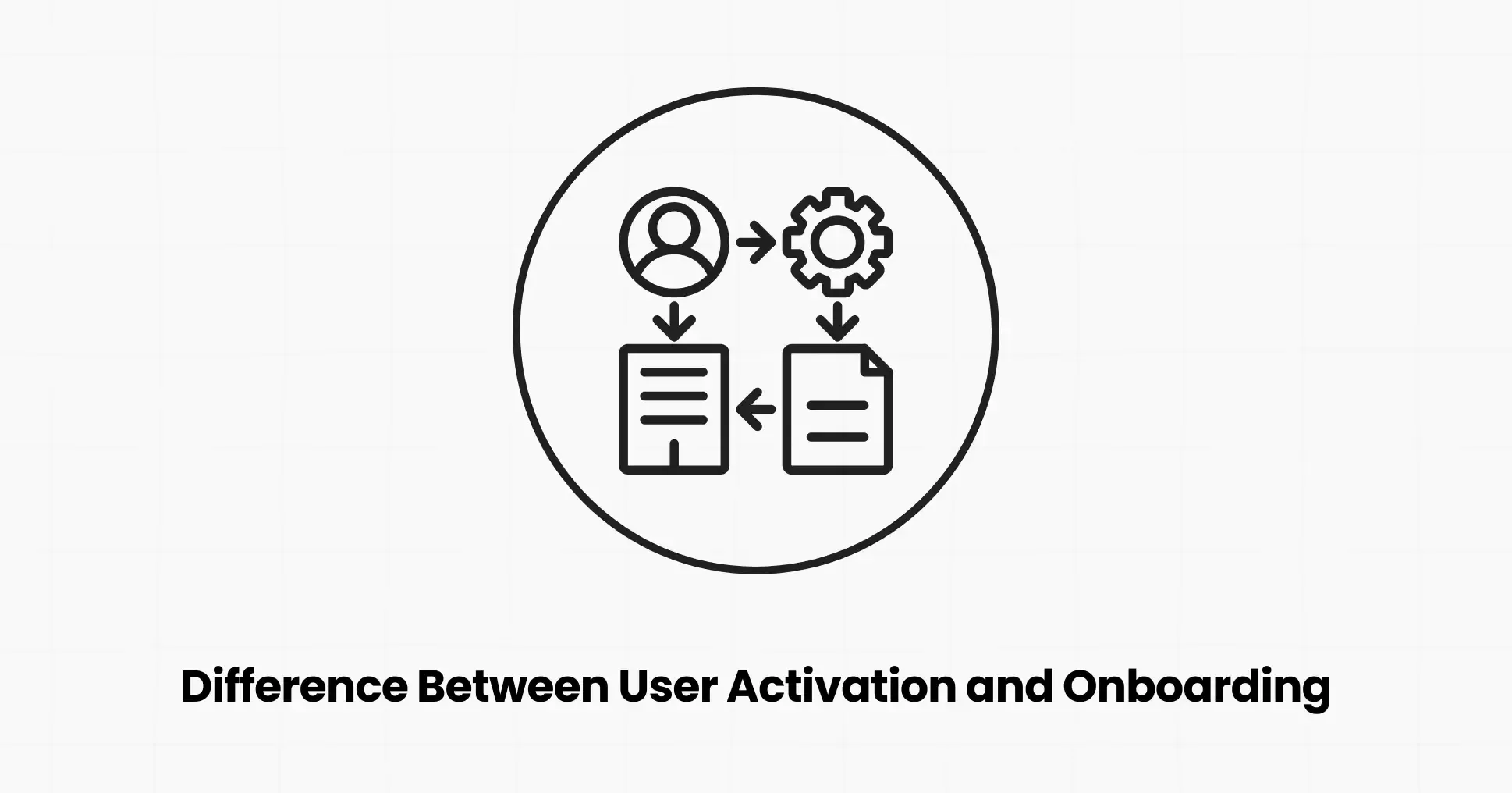
This is one of the most common points of confusion in product analytics, and it matters a lot to get right.
Onboarding is the process. It is the sequence of steps, tooltips, emails, checklists, and walkthroughs you use to guide a new user through your product.
Activation is the outcome. It is the moment the user actually gets the point.
You can have a perfectly designed onboarding flow and still have terrible activation rates. This happens when onboarding is built around teaching features rather than delivering value.
A simple way to think about it:
- Onboarding = showing someone around the kitchen
- Activation = the moment they taste the food and love it
The goal of onboarding should always be to produce activation. If your onboarding flow is not designed to get users to that first meaningful outcome as fast as possible, you are optimizing the wrong thing.
A product tour that takes 15 minutes to walk through every feature is not onboarding done well. It is friction dressed up as helpfulness.
What is an Activation Event in Product Analytics?
An activation event is the specific, trackable user action that statistically predicts long-term retention for your product. It is not arbitrary, and you should not guess at it. The best activation events are discovered through behavioral data.
How to find your activation event:
- Analyze retained users: Identify those who remain active after 30 or 90 days. What did they do in their first session that churned users did not?
- Identify the behavioral signal: It is almost always a core feature action, not a setup step.
- Validate it statistically: Your activation event should show a strong correlation with Day-7 or Day-30 retention in your cohort data.
Common activation events by product type:
- Project management tool: Created a real task and invited at least one teammate
- Analytics platform: Connected a live data source and viewed a report
- Design tool: Produced and exported a finished asset
- Communication tool: Sent messages and received replies within the same session
Notice that none of these are “completed the tutorial” or “filled out a profile.” Those are setup steps. An activation event delivers tangible output to the user. There is a before and after. Something changed.
What is Time to First Value in SaaS?
Time to First Value (TTFV) is how long it takes a new user to reach their activation event from the moment they sign up.
The faster, the better. Every extra minute of friction before a user experiences value is another minute where they might close the tab and never return.
For B2B SaaS, a widely accepted target is getting users to their first value moment within 15 minutes of signup. For consumer tools, that window is even shorter.
Strategies that reduce time to first value:
- Remove optional fields from your signup form and collect them later
- Skip profile setup until after the activation event
- Design onboarding around one core action, not a feature checklist
- Use pre-populated templates or sample data so users see results immediately
- Ask a single intent question at signup (“What are you trying to do?”) and route users to the relevant first experience
Figma’s onboarding is a strong reference point here. Instead of a feature tour, they ask new users to create a file, draw a shape, and invite a collaborator. Each step produces real output. By the end of onboarding, the user has made something.
How Product Analytics Helps You Track and Improve Activation
Once you have defined your activation event, you need a product analytics setup that can actually track it. That means:
- Custom event tracking so you can instrument your specific activation milestone
- Funnel reports that map drop-off between signup and first value
- Individual user journey views, so you can see what activated users do that others do not
- Cohort analysis to measure activation rates over time and catch regressions early
- Segment filtering to compare activation across acquisition channels, user roles, or device types
This is where a tool like Vemetric becomes directly useful.
Vemetric gives SaaS founders and product teams event tracking, funnel reports, and individual user journey timelines in one place, without the implementation complexity of enterprise analytics platforms.
You can define your activation event as a custom event, build a funnel from signup through to that event, and see both aggregate drop-off rates and the individual paths real users take.
That combination tells you not just that users are dropping off, but where and why.
Vemetric is also GDPR-compliant, cookie-free by default, open source, and free to get started for smaller projects.
FAQs
Yes, and for products with multiple user personas, you often should. A developer and a marketing manager using the same tool may have entirely different paths to value. Tracking a single activation event across all personas produces averages that hide what is actually happening for each group. Define one primary activation event, then segment by persona to find secondary ones.
The mechanic is the same, but the urgency is higher. Users on a time-limited trial face a hard deadline, so time-to-first-value becomes critical. If your activation event typically takes three days to reach and your trial is seven days, you have a thin margin for error. Free-trial products should optimize activation even more aggressively than freemium products.