You have a SaaS product. You need to know which features users actually engage with, where they drop off in your onboarding funnel, and what drives people to upgrade or churn.
But you also have European users. And the moment you install a traditional analytics tool, you’re one regulatory complaint away from a very expensive problem.
Here’s what most SaaS founders get wrong: they think GDPR compliance means choosing between knowing your users and respecting their privacy. It doesn’t.
The right setup gives you full product analytics, no cookie banner required, and zero exposure to EU enforcement action.
This guide breaks down exactly how.
Why GDPR Is Now an Active Enforcement Problem (Not a Future Risk)
GDPR has been in place since 2018, but 2025 and 2026 significantly raised the stakes. Regulators stopped issuing warnings and started issuing invoices.
European regulators issued approximately €1.2 billion in GDPR fines in 2025 alone. That’s not a rounding error.
The cumulative total across all documented enforcement actions has now passed €5.65 billion since the regulation came into force.
Analytics tools have been a primary target. Regulators in Austria, France, Italy, and the Netherlands have all issued findings against Google Analytics, citing inadequate protection for data transfers to the US.
The pattern is consistent: any tool that sends EU user data to US servers without proper safeguards is exposed. The burden is on you, the product owner, not on the analytics vendor.
Marketing analytics workflows, data transfers between platforms, and the analytics stack itself are now explicit enforcement priorities.
For SaaS founders targeting European users, this is operational reality, not legal theory.
What GDPR Actually Requires for Analytics
GDPR compliance for analytics comes down to three things:
1. Lawful basis for processing
You need a documented reason to collect user data. The two most relevant bases for product analytics are:
- Consent: The user explicitly agrees to tracking
- Legitimate interest: You have a proportionate business need that doesn’t override user rights
The ePrivacy Directive requires consent for non-essential cookies and tracking technologies regardless of any GDPR legal basis.
This covers analytics cookies, advertising pixels, social media tracking, and fingerprinting.
The keyword is “cookies.” If you’re not using cookies, you sidestep the ePrivacy layer entirely and can potentially rely on legitimate interest for basic, anonymized analytics.
2. Data minimization
Collect only what you actually need. IP addresses, device fingerprints, and persistent user identifiers are all “personal data” under GDPR. If your analytics platform stores them, you’re processing personal data, and you need a valid legal basis.
3. Data location and transfer rules
The Austrian DPA ruling closed the Standard Contractual Clauses loophole that many US-based SaaS tools had relied on for GDPR compliance claims.
If your analytics data flows to US servers without adequate transfer mechanisms, you’re exposed, even with a DPA in place.
The simplest path: use a tool that doesn’t collect personal data in the first place. No personal data, no GDPR obligations for that processing activity.
The 4 SaaS Metrics You Can’t Afford to Miss (And How to Track Them Compliantly)

1. Feature Adoption
Which features are actually being used?
Without this, you’re building based on assumption.
You need custom event tracking that fires when a user completes a specific action.
The GDPR-compliant way to do this is with cookieless event tracking tied to a hashed user identifier, rather than a persistent cookie or a raw IP address.
2. Activation Rate
What percentage of signups reach your target?
This requires funnel tracking from signup through your key activation event.
The good news is that, for logged-in users, you can tie events to an internal user ID (a pseudonymous identifier you control), which keeps you in compliance.
3. User Journey and Drop-off Points
Where do users give up? Session-level event streams, grouped by day and device, give you this without needing personally identifiable information.
4. Referral and Traffic Attribution
Where are your best users coming from?
UTM parameter capture, referrer detection, and top-of-funnel source data can all be gathered without cookies if your analytics tool supports them natively.
GDPR Analytics: The Options Compared
Not all “GDPR-compliant” claims are equal.
Here’s how the main approaches break down:
Option A: Google Analytics 4 with Consent Mode
Possible, but painful. Google Analytics 4 uses cookies and collects user data, such as location, device, and behavior, which is subject to GDPR when processing data from EU citizens. Compliance depends entirely on your configuration and ongoing EU regulatory rulings.
To run GA4 compliantly in the EU, you need a consent management platform, a correctly configured consent banner, a Data Processing Agreement with Google, and documentation of your lawful basis.
Even then, a meaningful percentage of users will withhold consent to analytics under GDPR, leaving your GA4 data structurally incomplete.
A business seeing 100,000 sessions in GA4 may actually be receiving 160,000 sessions once blocked traffic is accounted for.
Conversion rates calculated on undercounted denominators overstate actual performance.
You’re doing a lot of compliance work to get less accurate data.
Option B: Self-hosted or EU-based Cookieless Analytics
This is where GDPR complexity drops sharply. Tools that are:
- Cookieless by default
- Hosted on EU servers
- Not collecting IP addresses or personal identifiers
- Open source (so you can verify what they actually do)
Operate outside the ePrivacy Directive’s consent requirement and have a clean GDPR posture.
Cookie-free analytics can capture more complete traffic data without consent banners.
The era of cookie-dependent analytics is largely over, with Safari, Firefox, and Chrome all tightening restrictions.
How Vemetric Handles This
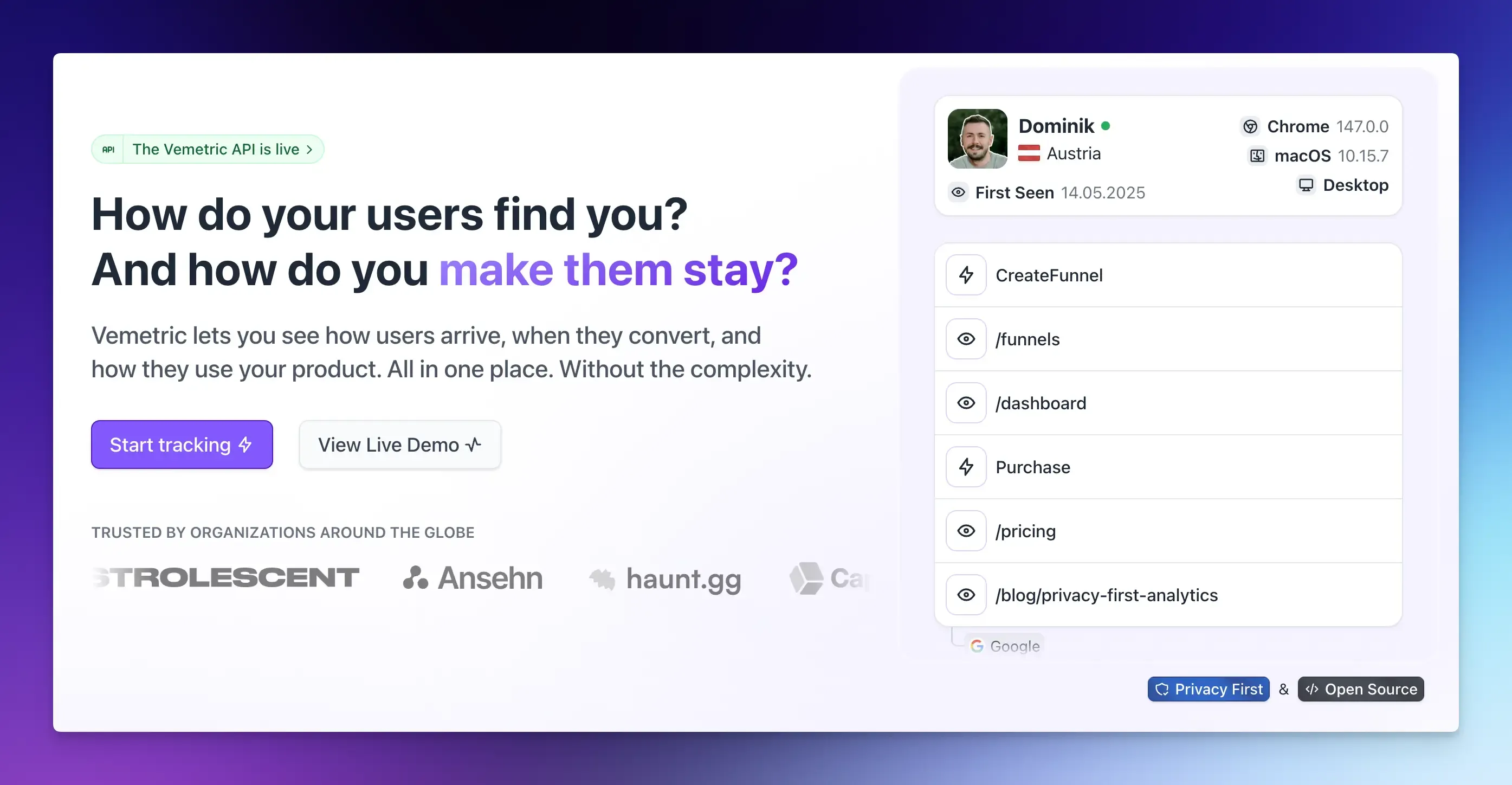
Vemetric was built specifically for SaaS products that need both web analytics and deep product analytics in one tool, without the GDPR complexity.
Here’s what makes it structurally compliant:
No cookies by default:
Vemetric doesn’t drop any cookies unless you explicitly opt in after getting user consent. To identify returning visitors on the same day, it generates a unique hash using a daily-rotating salt, not a persistent cookie or stored IP address.
EU-based servers:
Data is processed and stored on EU servers, with Cloudflare’s GDPR-compliant infrastructure handling proxying. There’s no risk of US data transfer.
Open source:
The codebase is publicly available on GitHub under the AGPLv3 license. You can verify exactly how data is handled rather than taking a vendor’s word for it.
Product analytics built in:
This is what separates Vemetric from lightweight traffic counters.
You get:
- Full user journey tracking (including merging anonymous and logged-in activity)
- Funnel analysis with drop-off visibility at each step
- Custom event tracking with real-time event streams
- Individual user profiles with session-level detail
- Top pages, referrers, and traffic sources, including ChatGPT referrals
All of this without a cookie consent banner. No CMP required. No consent audit trail to maintain.
Simple pricing:
Free plan for up to 2,500 events per month across 2 projects. Professional plan starts at $5/month for 10,000 events, 5 years of data retention, and unlimited projects.
What to Look for in Any GDPR-Compliant Analytics Tool
Before committing to any tool, run through this checklist:
- Does it use cookies by default? If yes, you need consent infrastructure.
- Where are the servers located? EU-based is safest under current enforcement patterns.
- Does it collect IP addresses? If so, how are they handled?
- Is there a publicly available Data Processing Agreement?
- Is the codebase auditable? Open source removes the need to trust vendor claims.
- Does it offer product analytics features (funnels, user journeys, events) or just traffic data?
- What does the pricing look like at scale? Some tools are cheap at low volume but expensive at the growth stage.
Final Words
Tracking SaaS product metrics under GDPR is not an either/or problem.
The mistake is installing tools built for a pre-GDPR world and then trying to bolt compliance on afterward.
The simpler path is to choose a tool designed for this constraint from the ground up. No cookies. EU servers. Open source so you can verify the claims.
Full product analytics so you don’t sacrifice insight for compliance.
That’s the setup that lets you know exactly which features are driving activation, where users are dropping out of your funnel, and which channels are sending you your best customers, without any regulatory exposure.
FAQs
No. If your analytics tool doesn’t drop cookies or collect personal data, the ePrivacy Directive’s consent requirement doesn’t apply to it. You can remove the banner entirely.
Not yet, but a self-hostable Community Edition is in the works. The cloud version already runs on EU servers, so most teams don’t need self-hosting for compliance purposes.
Vemetric continues tracking all events. Dashboard access is restricted if you exceed the limit repeatedly, so upgrade before that happens.