Your organic traffic is falling. Your keyword rankings look fine. Your Google Search Console shows more impressions than ever.
Something doesn’t add up, and it’s not a bug.
It’s Google AI Overviews, and they’re quietly rewriting the rules of SaaS analytics while most teams are still staring at the same dashboards they built in 2022.
If you run a SaaS product and rely on web analytics to understand where your users come from, this is one of the most important shifts you need to understand in 2026.
Let’s break down what’s actually happening, what’s broken in traditional analytics, and what you should be tracking right now.
The Numbers That Should Concern Every SaaS Team
Before diving into solutions, it helps to understand the size of what’s changed.
- Google AI Overviews now appear on approximately 55% of all search queries as of early 2026 (BrightEdge), up from around 31% in February 2025
- For B2B technology queries specifically, AI Overviews appear 82% of the time (BrightEdge, February 2026), meaning nearly every informational search your SaaS buyers run is getting summarized.
- 68% of all Google searches now end without a single click to any website, according to SparkToro and Similarweb’s June 2026 study covering January through April 2026 data
- For queries with an AI Overview, the zero-click rate climbs to 83%; 8 out of 10 users get their answer without leaving Google.
- Organic CTRs on AI Overview-affected queries have dropped by 34.5% to 61%, depending on query type, according to Ahrefs and Seer Interactive’s primary research.
- 73% of B2B websites experienced meaningful traffic loss between 2024 and 2025, with an average year-over-year decline of 34%
The paradox is that search impressions actually went up.
BrightEdge data shows impressions jumped 49% year over year while click-through rates dropped 30%.
Your brand is being seen more than ever inside Google. People just aren’t clicking through to your site.
This is what researchers are calling the Great Decoupling: impressions rising while actual visits fall off a cliff.
The Metrics That Actually Matter Now
Running a SaaS in modern AI overviews and generative AI engines means you need two sets of metrics: the ones that tell you what’s happening on your site, and the ones that tell you how you’re showing up before anyone reaches your site.
AI Referral Traffic (The Clicks That Are Still Coming)
This is the most actionable starting point. Even though most AI searches end without a click, some do result in visits, and those visitors are significantly more qualified.
AI-referred visitors convert at 14.2% compared to 2.8% for Google Search, according to the 2026 Opollo AI Search Benchmark Report. The buyer arrived already pre-qualified by the AI’s answer.
What to measure:
- Sessions from AI sources over time (track week over week)
- Which landing pages receive AI referral traffic
- Conversion rate for AI-sourced sessions vs organic search sessions
- Engagement rate differences between AI traffic and other channels
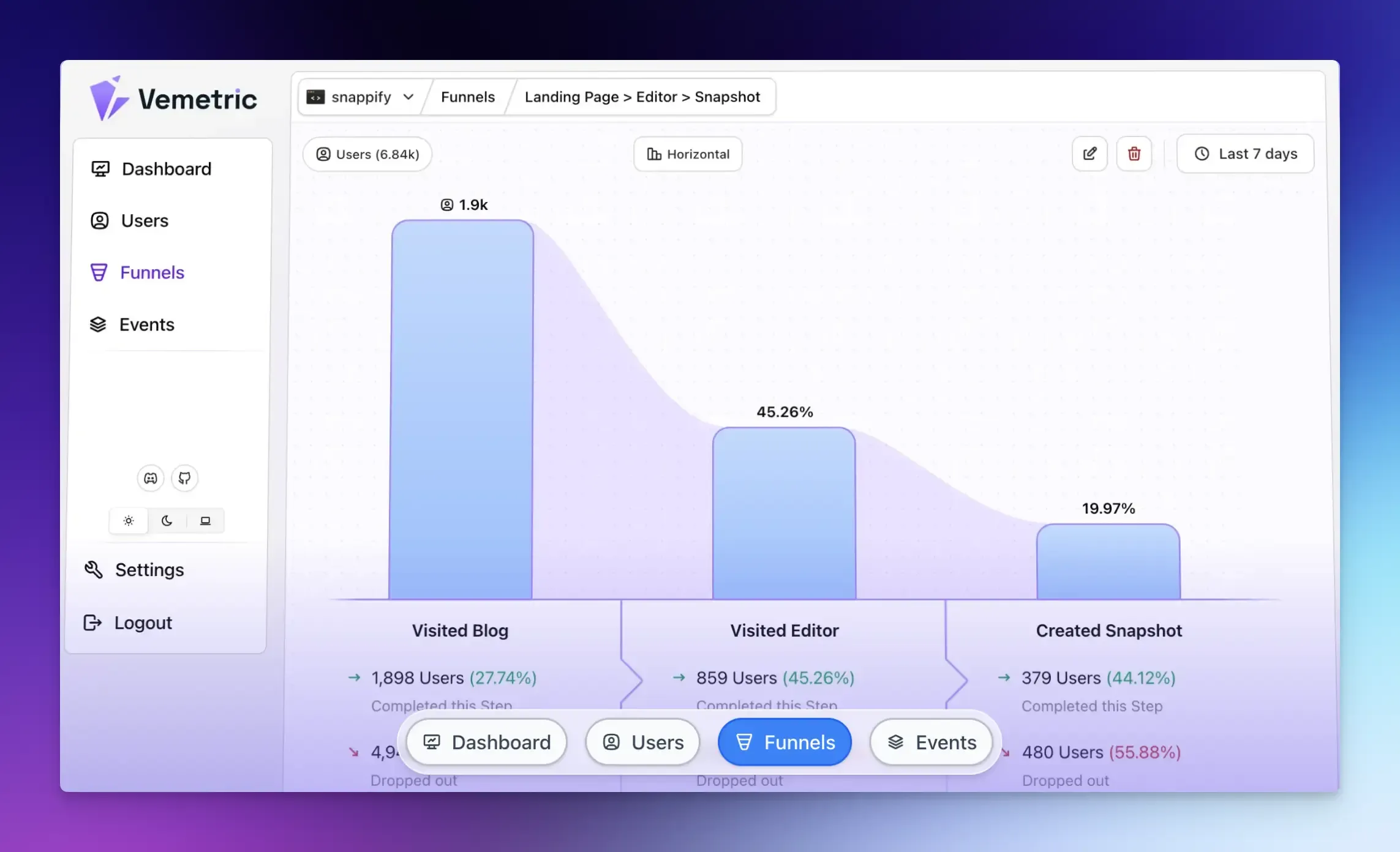
If you use a tool like Vemetric, you can spot AI referral patterns directly in your referrer data, including ChatGPT referrals, and see which pages are being cited by AI tools without having to build custom GA4 configurations from scratch.
AI Citation Rate
This is the AI equivalent of a backlink. It measures how often AI tools include your brand or content URL as a source when generating an answer.
Being cited means the model treats you as authoritative. It builds brand impressions even when people don’t click, and it shapes the buyer’s mental shortlist before they ever visit your pricing page.
How to track it (manual method):
Run 20 to 30 queries related to your product category across ChatGPT, Perplexity, Claude, and Google AI Overviews. Use queries your ideal customer would ask:
- “What is the best analytics tool for SaaS startups?”
- “How do I track user behavior in a SaaS product?”
- “What is an alternative to [competitor name]?”
Record whether your brand is mentioned, whether a URL is cited, and how your product is described. Build a spreadsheet and repeat monthly.
Automated alternatives: Dedicated AI visibility tools like Surfer AI, Gauge, and Peec AI run thousands of prompts across multiple models automatically. These are worth the investment if your team runs campaigns at scale.
Brand Mention Rate in AI Answers
This is similar to the citation rate, but tracks mentions without a direct URL.
If someone asks “what tools help with SaaS product analytics?” and an AI says “tools like Vemetric, Mixpanel, and Amplitude,” that’s a brand mention even without a link.
This matters because 85% of AI brand mentions come from third-party sources, not your own website.
Mentions from G2, review aggregators, comparison articles, and editorial coverage directly influence how AI models talk about your brand.
What to do with this data:
- Identify which competitor brands appear in answers where yours doesn’t
- Find the third-party sites that AI tools pull from most frequently
- Prioritize getting your brand mentioned on those domains
Impression-to-Click Decoupling in Search Console
Set up a custom Search Console report that compares impressions and clicks for your top 50 informational queries. Calculate the ratio and track it monthly.
A widening gap between impressions and clicks on a specific set of keywords almost always means AI Overviews are absorbing those queries.
You can often confirm this by manually searching those terms in Google and checking whether an AI Overview appears.
This is how you identify which parts of your content strategy are being affected most and prioritize your response.
Direct Traffic as a Proxy for Dark AI Influence
This is an imperfect but useful signal. When AI-influenced buyers visit your site later by typing your URL directly, they show up as direct traffic.
A clean way to detect this pattern is to cross-reference spikes in direct traffic with increases in AI referral sessions. If both go up together, dark AI influence is likely growing.
Support this with qualitative data. Add a simple “How did you hear about us?” question to your onboarding flow or trial signup. It’s a blunt instrument, but it captures attribution that no analytics tool can see.
Feature Adoption and User Journey Metrics (Not Just Acquisition)
Here’s a SaaS-specific point that doesn’t get enough attention: when AI Overviews reduce the volume of informational query traffic, the visitors who do arrive tend to be further along in the buying journey. This changes the way your funnel metrics should look.
You should see:
- Shorter time to first key action
- Higher trial-to-paid conversion rates
- Lower bounce rates on pricing and product pages
- More direct demo requests relative to total traffic
If you’re tracking user journeys with a tool that merges anonymous and logged-in activity (like Vemetric’s user journey feature), you can actually trace whether AI-referred visitors behave differently from organic search visitors from first touch through to conversion.
That’s where the real insight lives.
What to Do When You Find Gaps
If your brand isn’t showing up in AI searches for your category, here’s what actually moves the needle:
Structured, direct content wins citations:
AI models heavily favor content that answers the query in the first paragraph, uses clear headings, and comes from domains with topical authority. Long introductions and generic keyword-stuffed posts get deprioritized.
Third-party mentions matter more than they used to:
Since 85% of AI brand mentions come from external sources, getting into comparison articles, software review sites, and editorial roundups is no longer just a nice-to-have. It’s a core channel.
Branded search is your floor:
Even as informational queries move toward zero-click, buyers who already know your name still search for you directly. Protect and grow branded traffic as a base.
Update content frequently:
AI systems prioritize accurate, recent information. Stale posts that haven’t been updated in 18 months are less likely to get cited.
Watch what AI says about your product:
AI models sometimes misrepresent brands, describe outdated pricing, or attribute features you don’t have. Monthly prompt audits catch this before it shapes buyer perception at scale.
Final Words
The shift from traditional SEO metrics to AI-aware analytics is not a problem for the future. It’s already affecting how your funnel performs.
Your analytics stack needs to answer two questions it probably couldn’t answer a year ago:
- How often does our brand appear in AI-generated answers our buyers are seeing?
- When AI sends someone to our site, what do they do, and do they convert?
Tools like Vemetric are well-suited for the second question, connecting the AI referral source to actual user behavior, feature adoption, and conversion in a single dashboard without needing a separate product analytics tool layered on top of a web analytics tool.
FAQs
Yes, but differently. High-ranking pages are more likely to get cited inside AI Overviews, which drives brand impressions even without a click. Commercial-intent queries (pricing, comparisons, alternatives) still generate meaningful click rates. Informational content is where click loss is most vertical.
Yes, and it happens more often than teams realize. Models occasionally cite outdated pricing, attribute features incorrectly, or confuse similar products. Monthly prompt audits catch this before it shapes buyer decisions at scale.
Check whether your site is blocking AI crawlers (GPTBot, ClaudeBot, PerplexityBot) in your robots.txt. According to Fuel Online’s research, 27-34% of SaaS companies are blocking at least one major AI crawler without realizing it, making their content invisible to the models buyers are using.